Cage Bedding Is a Variable, Not a Given
Posted on August 5, 2026
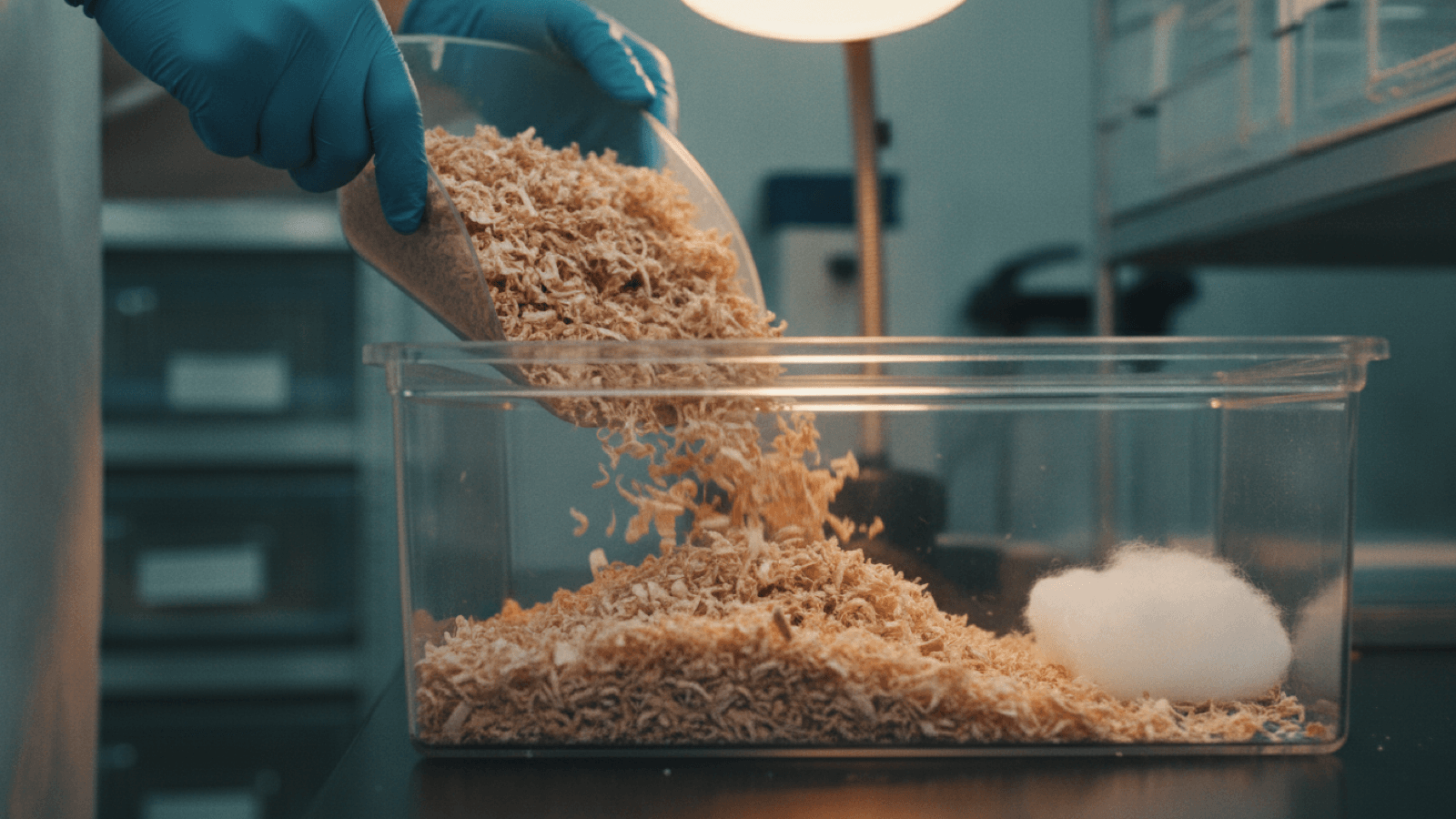
Bedding gets bought like a shop supply: whatever’s in stock, whatever’s cheapest, swapped when a vendor backorders. It doesn’t behave like one.
Ask a facility manager what changed in a study this quarter, and cage bedding rarely makes the list. Housing density, light cycle, cage design: those get logged. Bedding gets bought in bulk, swapped when a vendor has a backorder, and treated like a consumable that sits under the experiment rather than inside it. That’s the part worth correcting. Rodents burrow in bedding, breathe through it, and in the case of corncob, eat a fair amount of it. Whatever’s in the substrate rides along in the data, whether anyone wrote it into the protocol or not.
What corncob puts into the bloodstream
Corncob is one of the most common bedding substrates in U.S. vivariums: cheap, absorbent, low-dust. It also carries naturally occurring tetrahydrofuran-diols, or THF-diols, left over from how the cob is processed. Villalon Landeros and colleagues measured a corncob bedding extract at roughly five times more trans– than cis-THF-diol, then found that California mice housed on that bedding absorbed it: their brains showed significantly fewer estrogen receptor-alpha positive cells in two regions that govern social and aggressive behavior, compared to mice on cardboard bedding. The behavioral readout was just as direct. Blocking aromatase raised aggression in the cardboard-housed mice. In the corncob-housed mice, the same drug did close to nothing. Same manipulation, same dose, opposite result, because the bedding was already doing its own quiet endocrine work underneath the one the study was designed to test.
That finding was in California mice, a less common lab species, which raises a fair question: does corncob move the needle in the C57BL/6J mouse most labs actually house? A 2023 study says yes, through a different door. Sveeggen and colleagues fasted C57BL/6J-background mice overnight on corncob versus paper pulp cellulose and found the corncob group ran meaningfully higher fasting blood glucose, roughly 90 to 100 mg/dL versus 70 to 80, and in one of the two strains tested, a blunted vascular response to a standard pressor drug. Corncob, they concluded, acts as an unlogged food source, not an inert surface under the cage.
| Measure | On the control substrate | On corncob |
|---|---|---|
| Estrogen receptor-alpha cells dorsal BNST and VMH |
Baseline, on cardboard | Significantly fewer |
| Response to aromatase blockade | Aggression rose: more bites, shorter attack latency | Effect absent |
| Fasting blood glucose | 70 to 80 mg/dL, on paper pulp cellulose | 90 to 100 mg/dL |
| Vascular response to a pressor drug | Normal | Blunted, in one of two strains |
What accumulates in cage bedding between changes
Bedding also sets the atmosphere an animal actually breathes at nose height, a much closer reading than whatever the room’s HVAC reports. As urine and feces break down, ammonia builds inside the cage, and the literature is blunt about the ceiling: researchers behind a 2023 study on ventilated caging note that no report has come back clean once intracage ammonia crossed 50 ppm, and say they’d rather hold levels under 25 ppm for the whole cycle, not just avoid crossing a line by the last day. The same team also tested the obvious lever, and it didn’t work: running half the standard bedding, or half again as much, moved intracage ammonia not at all, across both cage sizes and every stocking density they tried. Density and change frequency drive ammonia. The amount of bedding doesn’t.
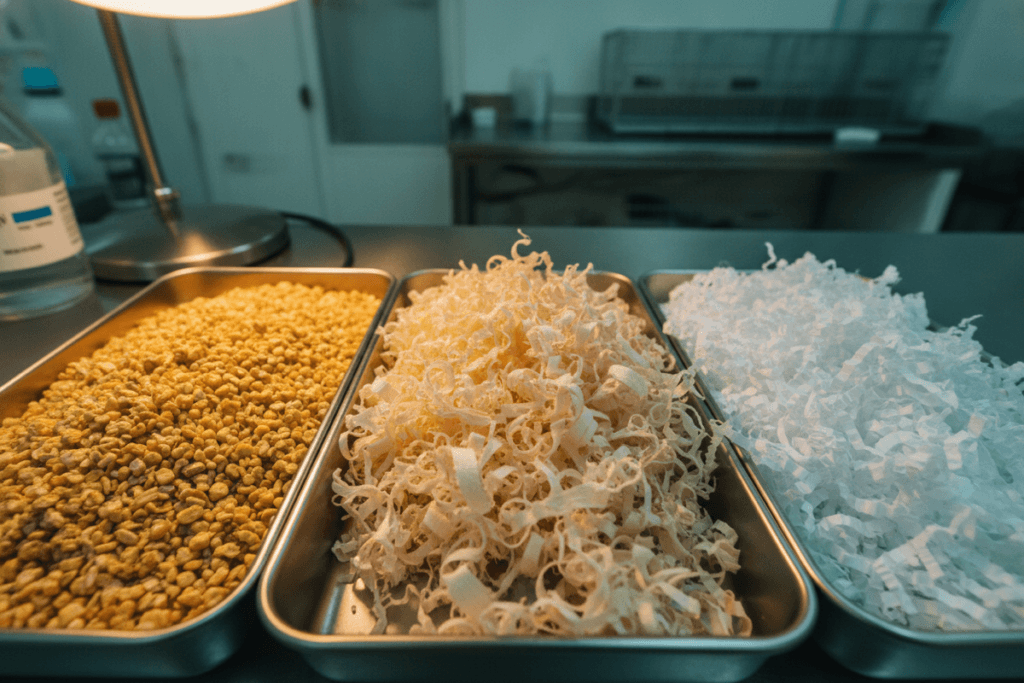
Substrate choice compounds the problem, and which substrate counts as safe isn’t fixed. An older four-way comparison of common beddings found corncob, aspen chip, and recycled newspaper all held ammonia in check on ordinary weekly (static) or biweekly (ventilated) change schedules, while reclaimed wood pulp didn’t: mice housed on it developed nasal epithelial damage within a single week, a substrate swap alone driving a pathology finding nobody was studying for. A more recent four-way comparison in ventilated caging complicates the aspen half of that picture: across a two-week cycle, 85% of aspen-bedded cages crossed the 50 ppm ceiling, against 10% of corncob cages, 10% of pelleted cellulose, and 5% of diced cellulose. Two cellulose products from the same category landed in different places, which is the real lesson. “Safe” depends on the specific product and caging system in front of you, not the substrate category on the invoice.
The part that isn’t chemistry
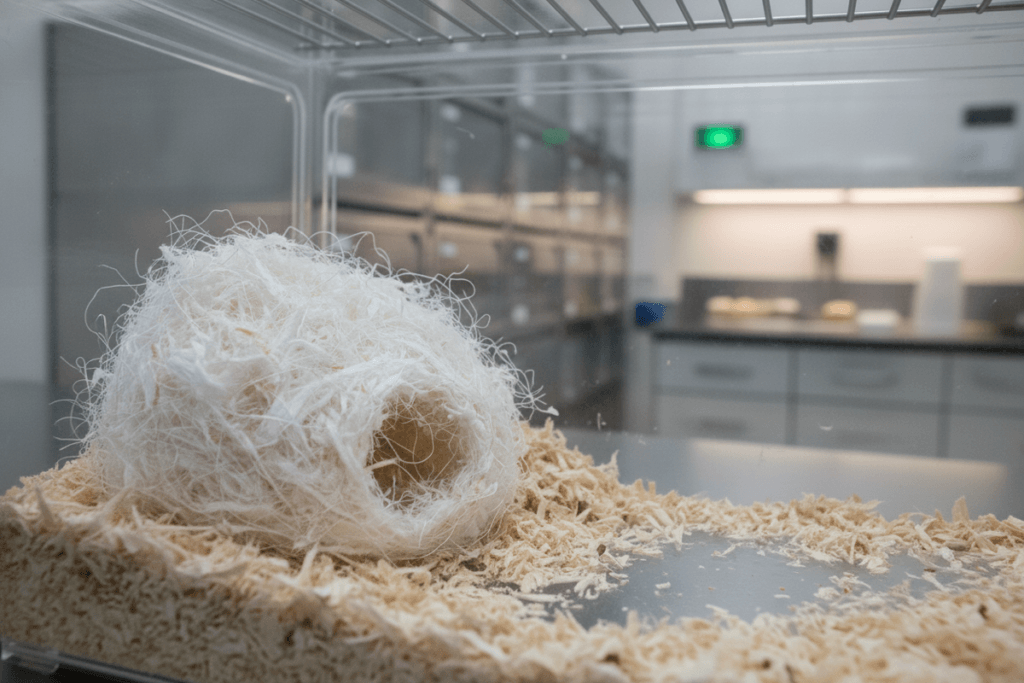
Not every bedding effect is a molecule. The Guide for the Care and Use of Laboratory Animals is explicit that contact bedding, given in adequate quantity, is what lets rodents forage, dig, burrow, and build a nest. Take that material away, or swap to something too fine or too coarse to hold a nest shape, and an animal’s ability to thermoregulate and self-soothe changes along with it, not just its comfort. A mouse that can’t build a proper nest is carrying a different baseline stress load than one that can, and stress hormones move plenty of the same downstream readouts, weight, behavior, immune markers, that a study is trying to measure cleanly.
What to actually control and document
Treat bedding substrate, lot, and supplier as a line in the protocol, not a facilities purchasing call. Four things follow from that:
- Match the substrate to the endpoint. Corncob is a reasonable default for plenty of work and a poor one for anything reproductive, behavioral, or estrogen-sensitive.
- Read ammonia against your actual change schedule, holding to the 50 ppm ceiling and aiming at 25 ppm, rather than spot-checking it the week of an audit.
- Qualify a new substrate on dust and irritation before you adopt it for price or supply, product by product, not category by category.
- Loop study staff into the purchasing conversation before the switch ships, not after someone notices the data moved.
The takeaway
Bedding is cheap, interchangeable, and easy to reorder without a second thought, which is exactly why it’s easy to leave off the list of things that could explain a shift in the data. That puts it in familiar company. We’ve made much the same case about a mislabeled cage card: the things that quietly cost you a study are almost never the exotic ones. The fix isn’t finding one universally correct substrate. It’s documenting whichever one is in the cage and treating a change to it like any other protocol amendment, because that’s what it actually is.
References
- Villalon Landeros, R., Morisseau, C., Yoo, H. J., Fu, S. H., Hammock, B. D., & Trainor, B. C. “Corncob bedding alters the effects of estrogens on aggressive behavior and reduces estrogen receptor-α expression in the brain.” Endocrinology 153(2): 949–953 (2012). pmc.ncbi.nlm.nih.gov
- Sveeggen, T. M., Isakson, B. E., Straub, A. C., & Bagher, P. “Bedding as a variable affecting fasting blood glucose and vascular physiology in mice.” American Journal of Physiology-Heart and Circulatory Physiology 325(2): H338–H345 (2023). pmc.ncbi.nlm.nih.gov
- Eskandarani, M. A., Hau, J., & Kalliokoski, O. “Rapid ammonia build-up in small individually ventilated mouse cages cannot be overcome by adjusting the amount of bedding.” Lab Animal 52(6): 130–135 (2023). pmc.ncbi.nlm.nih.gov
- Ferrecchia, C. E., Jensen, K., & Van Andel, R. “Intracage ammonia levels in static and individually ventilated cages housing C57BL/6 mice on 4 bedding substrates.” Journal of the American Association for Laboratory Animal Science 53(2): 146–151 (2014). pubmed.ncbi.nlm.nih.gov
- Tataryn, N. M., Buckmaster, C. A., Schwiebert, R., et al. “Comparison of four beddings for ammonia control in individually ventilated mouse cages.” Journal of the American Association for Laboratory Animal Science 60(1): 37–43 (2021). pmc.ncbi.nlm.nih.gov
- National Research Council (US). Guide for the Care and Use of Laboratory Animals, 8th ed. Washington, DC: National Academies Press, 2011. ncbi.nlm.nih.gov
About RapID Lab. RapID Lab makes minimally invasive, automated 2D-barcode ear tags for identifying rodents in preclinical research. We’re a small team in San Francisco focused on accurate, low-stress animal identification. rapidlab.com
This article is for general informational purposes and reflects RapID Lab’s perspective on industry practice. It is not husbandry or veterinary guidance, and it is not a substitute for your facility’s SOPs or attending veterinarian’s judgment.