The 3Rs in Practice: What Refinement Looks Like on a Tuesday
Posted on October 6, 2026
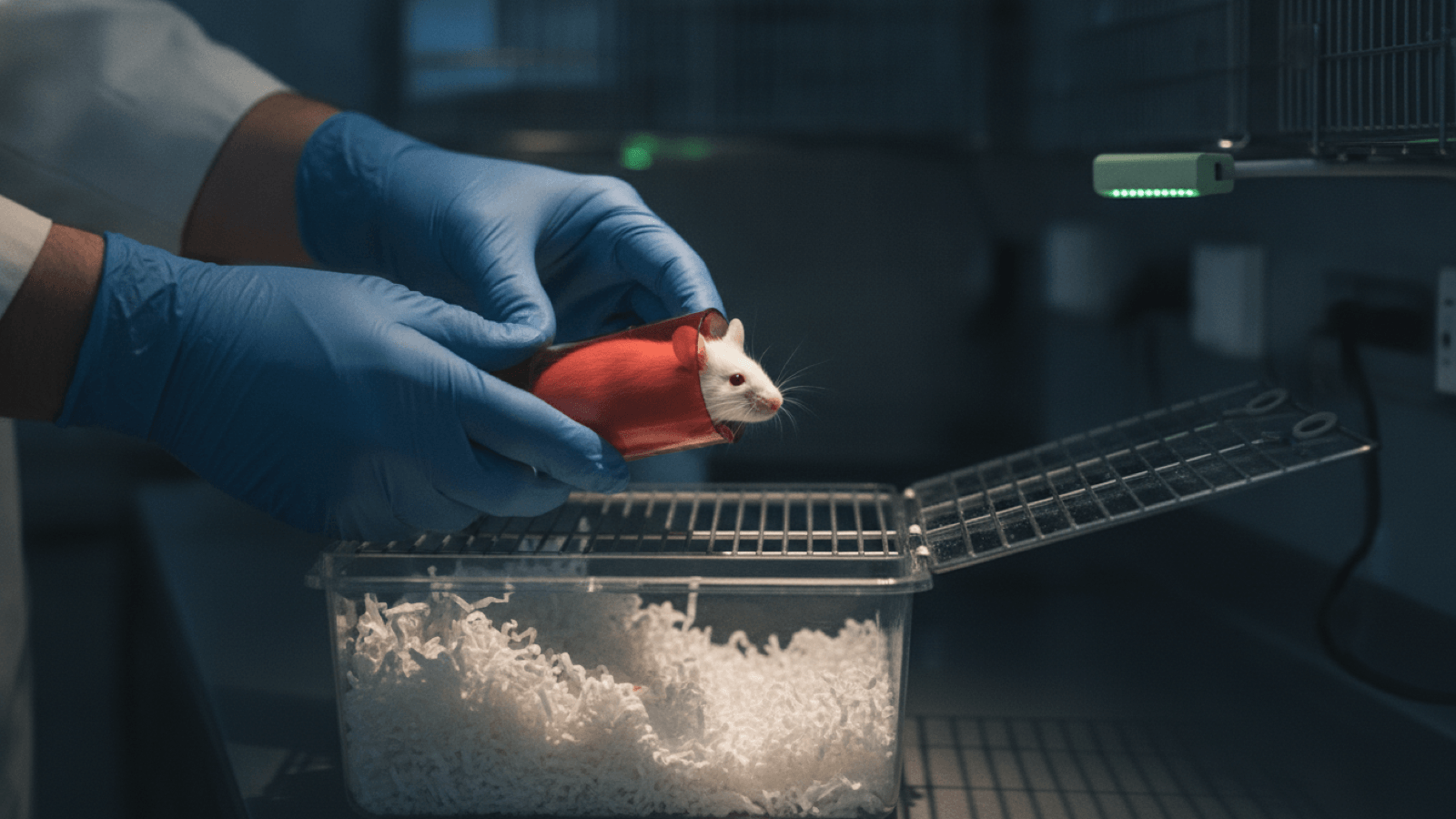
The 3Rs get taught as three words on a slide. On the floor, Refinement is a run of small choices a tech makes before lunch, and most of them never appear in a protocol.
Ask anyone in the field to define Refinement and you’ll get the short version: minimize pain and distress. Correct, and not much use at 7:30 on a Tuesday with a full rack to change.
The useful version of 3Rs refinement is smaller. It’s how an animal leaves its cage, what goes into the clean cage with it, whether it has felt the dosing grip before the day of dosing, and where it wakes up after surgery. None of it needs a protocol amendment. Most of it takes seconds.
Here’s one shift, in order, with the evidence behind each habit.
Look before you lift
The first check of the morning happens with the lid still on, and the nests do most of the talking.
The Guide sets mouse rooms at 20 to 26°C. It also puts the mouse’s thermoneutral zone at 26 to 34°C. That gap is on purpose: rooms run cool to avoid heat stress, and the Guide expects the animals to close the difference themselves by nesting and huddling.1 A well-built nest reaches 30 to 32°C inside, according to NC3Rs housing guidance.2
So a flat, scattered nest isn’t untidiness. It can mean an animal that’s cold, unwell, or short on material, and you can see it without touching anyone.
Post-op cages get a closer look. The Mouse Grimace Scale, published in 2010, gives staff a standardized way to code pain from a mouse’s face, with high accuracy and reliability between scorers.3 A few seconds of looking before the lid comes off is a welfare check that costs the animal nothing.
Cage change: move the nest, not the mess
For most mice, cage change is the biggest disturbance of the week. Cleaning strips the scent cues that group-housed males use to keep their social order, and NC3Rs notes it can set off fighting.4
The fix is a handful of paper. Carry some clean, dry, used nesting material into the fresh cage and leave the soiled bedding behind. In male BALB/c mice, Van Loo and colleagues found that transferring nesting material significantly reduced aggression after cleaning, while transferring soiled sawdust seemed to make it worse.5 NC3Rs now recommends exactly this.4
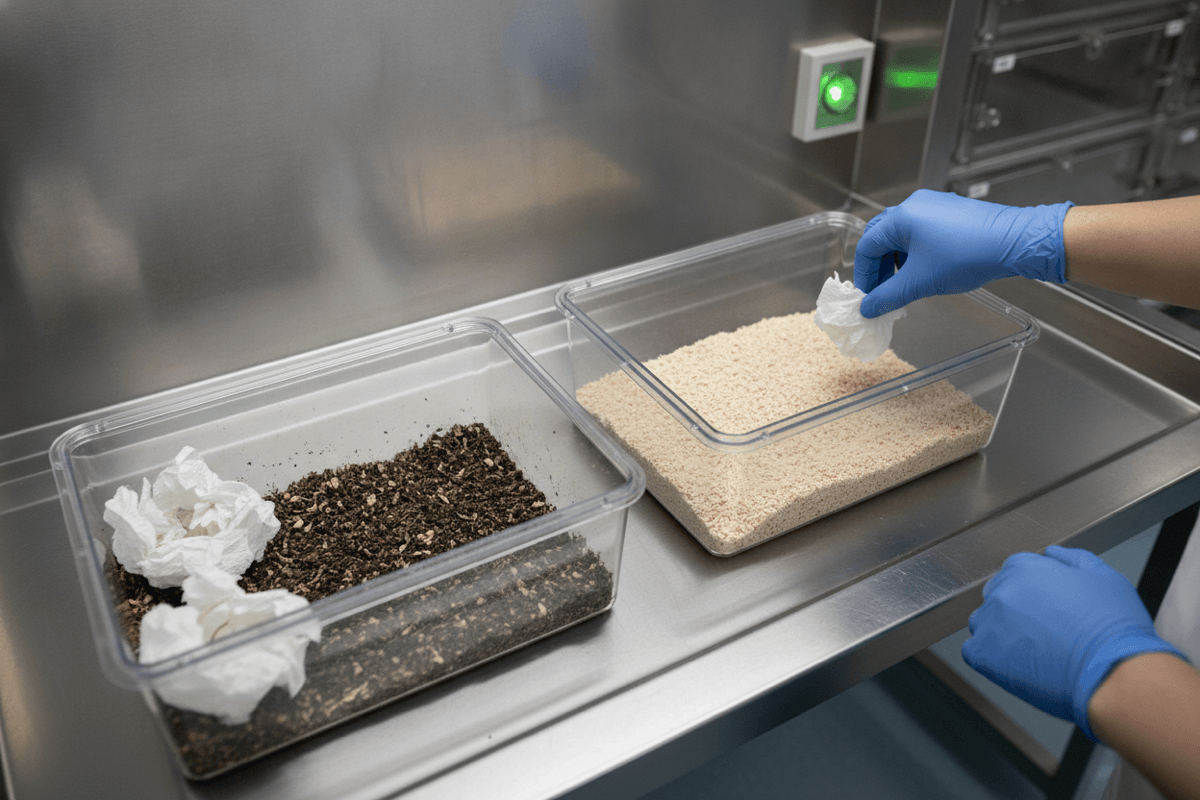
We’ve argued before that the bedding itself is an experimental variable. The nest is the part of it the animals built, and it’s worth keeping.
Pick them up without the tail
Tail pickup is fast and it’s what most people learned first. In Hurst and West’s 2010 study, mice picked up by the tail showed aversion and high anxiety. Mice lifted in a tunnel or cupped hands approached the handler voluntarily and accepted restraint.6 A 2020 follow-up found the tunnel’s benefit held up after repeated scruffing, injections and anaesthesia.7
The honest caveat: a 2025 study that handled mice only at weekly cage changes, over ten weeks, found no consistent welfare difference between tail and tunnel.8 The size of the benefit at routine handling frequency is still being argued. The cost isn’t. A tunnel already sitting in the cage is free.
Rehearse the procedure before it counts
A mouse’s first experience of the dosing grip shouldn’t be the dose.
A 2024 review in Laboratory Animal Research lays out what that looks like in practice.9
- Four to five short training sessions after arrival, starting with gentle handling.
- Practice the actual grip if the study includes oral dosing, finishing with water through a soft feeding tube.
- Fleece in the weighing box, so the scale feels less like a strange place.
- Food rewards to build a positive association with the steps that are coming.
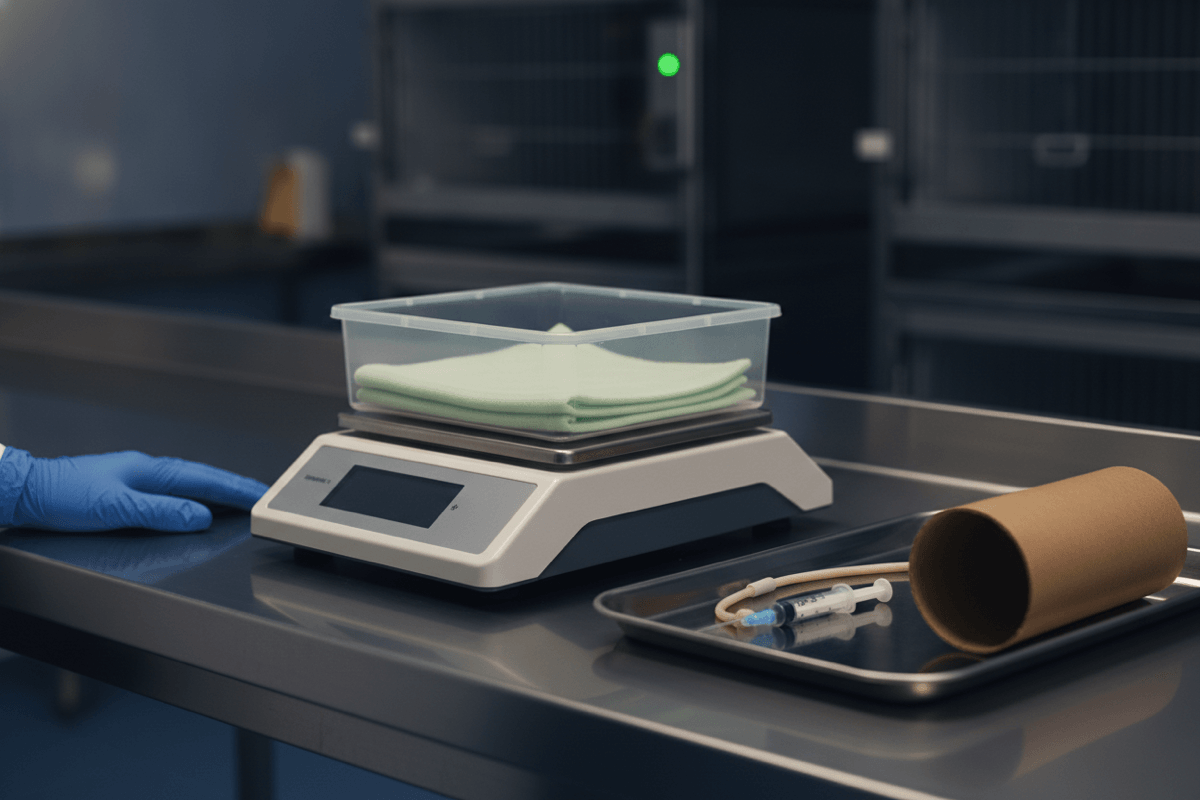
None of this needs special equipment or a formal program. It needs someone deciding that ninety seconds this week is worth it.
After surgery, warm first
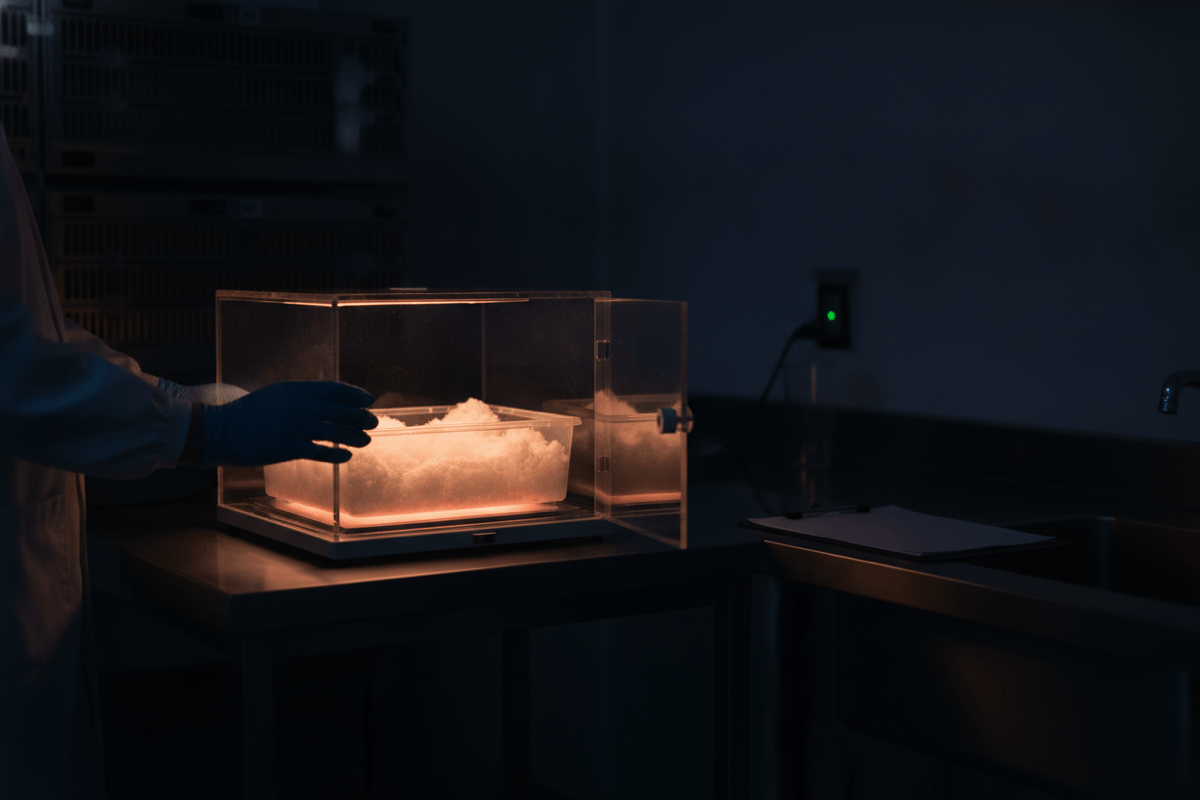
Mice lose heat fast under anaesthesia, and a room-temperature cage is a cold place to wake up. In a 2022 JAALAS study of 48 CD1 mice, animals recovered in a 38°C forced-air incubator averaged 38.8°C. Cage-recovered controls averaged 33.6°C.10
That five-degree gap is the case for a warm, quiet recovery spot, plus analgesia on schedule and a grimace check on afternoon rounds.
The whole shift on one page
| When | The habit | The evidence |
|---|---|---|
| Morning check | Read nests and faces before lifting a lid | Room 20–26°C vs thermoneutral 26–34°C (Guide); nest interior 30–32°C (NC3Rs); Mouse Grimace Scale |
| Cage change | Move clean used nest into the fresh cage; leave soiled bedding behind | Nest transfer cut aggression in male BALB/c mice (Van Loo 2000) |
| Pickup | Tunnel or cupped hands | Less anxiety, voluntary approach (Hurst & West 2010; Henderson 2020); effect at weekly-only handling debated (Meyer 2025) |
| Before the study | Four to five short sessions; practice the dosing grip; fleece in the weigh box | Rinwa et al. 2024 |
| Recovery | Warm incubator, analgesia on schedule, grimace check | 38.8°C vs 33.6°C after warmed vs cage recovery (Bailey 2022) |
Read down the middle column. Every item is a habit, not a purchase.
What it costs
The honest objection is time. A tech running a full rack on a tight morning doesn’t have unlimited minutes, and pretending otherwise doesn’t help. The cost is real but small: seconds per animal, not a new position on the budget. Whether it also shows up as cleaner data is a separate argument, and one we’ll take on in a later piece.
What refinement asks of a tech on an actual Tuesday isn’t heroic. A look before lifting. A tuft of old nest in the new cage. A tunnel. A rehearsal. A warm place to wake up.
References
- National Research Council. “Environment, Housing, and Management.” Guide for the Care and Use of Laboratory Animals, 8th ed. National Academies Press (2011). nationalacademies.org
- NC3Rs. “Housing and husbandry: Mouse.” nc3rs.org.uk
- Langford, D. J., et al. “Coding of facial expressions of pain in the laboratory mouse.” Nature Methods 7, 447-449 (2010). pubmed.ncbi.nlm.nih.gov
- NC3Rs. “Minimising aggression in group-housed male mice.” nc3rs.org.uk
- Van Loo, P. L. P., Kruitwagen, C. L. J. J., Van Zutphen, L. F. M., Koolhaas, J. M., & Baumans, V. “Modulation of aggression in male mice: influence of cage cleaning regime and scent marks.” Animal Welfare 9(3), 281-295 (2000). cambridge.org
- Hurst, J. L., & West, R. S. “Taming anxiety in laboratory mice.” Nature Methods 7, 825-826 (2010). nature.com
- Henderson, L. J., Dani, B., Serrano, E. M. N., Smulders, T. V., & Roughan, J. V. “Benefits of tunnel handling persist after repeated restraint, injection and anaesthesia.” Scientific Reports 10, 14562 (2020). pmc.ncbi.nlm.nih.gov
- Meyer, N., Gottschalk, R., Jakobi, L., Schönhoff, A.-M., & Touma, C. “Lack of evidence for a consistent differential impact of tail and tunnel handling on markers of welfare in laboratory mice.” Scientific Reports 15, 21534 (2025). pmc.ncbi.nlm.nih.gov
- Rinwa, P., Eriksson, M., Cotgreave, I., & Bäckberg, M. “3R-Refinement principles: elevating rodent well-being and research quality.” Laboratory Animal Research 40, 11 (2024). pmc.ncbi.nlm.nih.gov
- Bailey, K. T., Jantre, S. R., Lawrence, F. R., Hankenson, F. C., & Del Valle, J. M. “Evaluation of Active Warming and Surgical Draping for Perioperative Thermal Support in Laboratory Mice.” Journal of the American Association for Laboratory Animal Science 61(5), 482-494 (2022). pmc.ncbi.nlm.nih.gov
About RapID Lab. RapID Lab makes minimally invasive, automated 2D-barcode ear tags for identifying rodents in preclinical research. We’re a small team in San Francisco focused on accurate, low-stress animal identification. rapidlab.com
This article is for general informational purposes and reflects RapID Lab’s perspective on industry practice. It is not veterinary or regulatory advice, and it is not a substitute for your facility’s SOPs or IACUC-approved procedures.