Animal Identification: 7 Questions for Any Vendor at AALAS
Posted on October 20, 2026

Every identification booth in Houston will call its method reliable, humane and easy. These seven questions work at all of them, ours included.
The exhibit hall is the one week a year you can stand in front of every animal identification method in a single afternoon: ear tags, tattoos, microchips, notches, and whatever is new. It is also the week they all get the same three adjectives.
When a FELASA working group reviewed rodent identification methods, it concluded there is no gold standard, because each situation is unique. A method should identify reliably, be easy to apply, and not inflict adverse effects on the animal, given the type of research.1
So a ranking won’t help much. Questions will. Here are seven that work at any booth, whatever the method. We sell one of those methods, so we answer all seven ourselves at the end.
Animal identification you can trust: reads and losses
1. How was your read-error rate measured?
Every vendor has an accuracy claim. Fewer can tell you who did the reading, or under what conditions. A figure from clean tags read under good light at a bench says little about a technician reading a moving mouse on a busy cage-change morning. (We covered why that first read is where errors start in Cage Card to LIMS.)
A good answer names the readers, the number of reads, and whether the animals were in their cages or in hand. It also separates a read that fails, which costs seconds, from a read that returns the wrong animal, which can cost a study.
2. What is your loss rate, across how many animals, over how long?
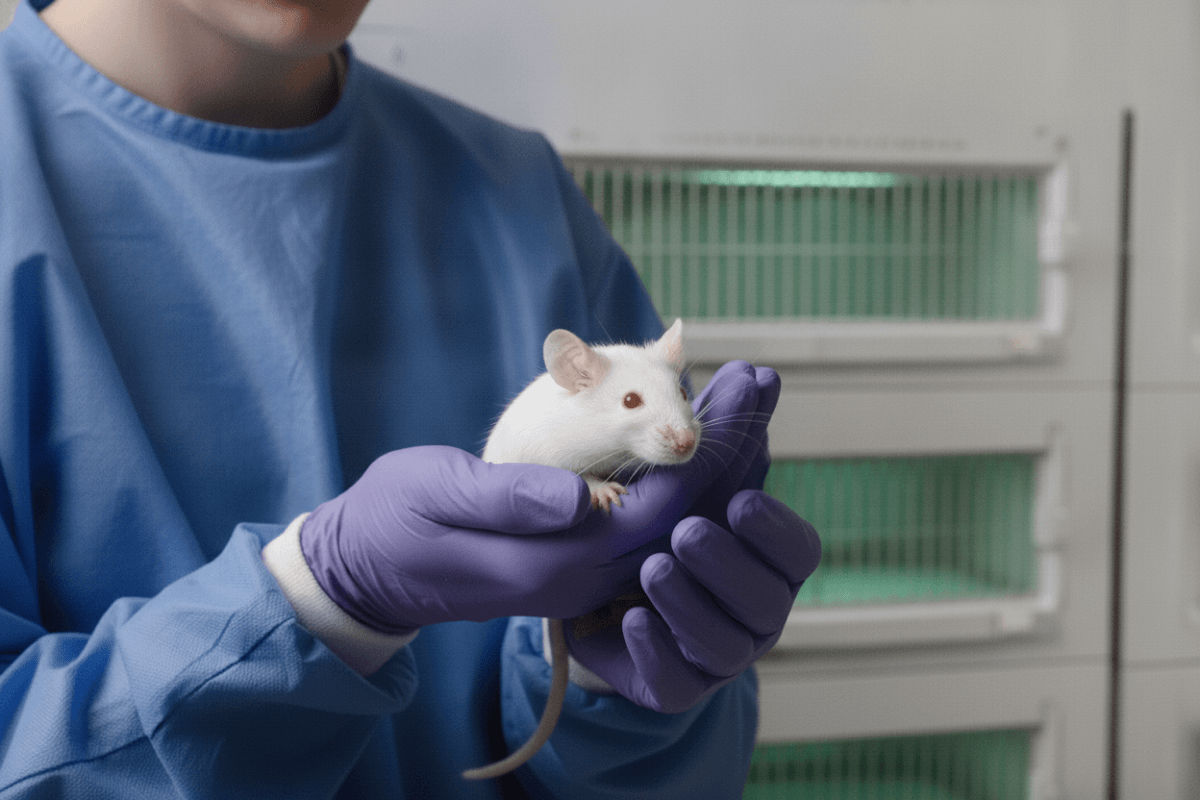
The same paper notes that ear tags can fall out,2 and a percentage with no denominator and no duration tells you little. Press hardest on duration. In a study of metal ear tags in C57BL/6 mice, visible thickening of the tagged ear was recorded 26 weeks after tagging.3 Ask what the site looks like at six months.
A good answer gives the number of animals, the months of follow-up, the strain and housing, and whether the figure came from a controlled study or from customer reports.
The animal: age, handling and imaging
3. How young can you apply it, and what does the animal need?
The youngest workable age decides whether a method fits a breeding colony at all. The Guide reserves toe-clipping for when no other individual method is feasible, allows that it may be preferred in neonatal mice up to 7 days old, and wants anesthesia or analgesia commensurate with age.4 A study that marked C57BL/6J pups on postnatal day 5 found transponder implantation the most distressful of three methods and concluded implants should wait for older pups or weaning.5
A good answer is a postnatal day, the restraint and anesthesia involved, and whether the mark ever has to be redone.
4. Has it been through the scanner we actually use?
“Compatible” is a slippery word in imaging. A 2025 paper imaged eight mice carrying implanted microchips marketed as MR-compatible. At 9.4 tesla, every one showed susceptibility artifacts. The authors describe large-scale signal loss across the posterior half of the brain, corrected by surgically removing the chips.6
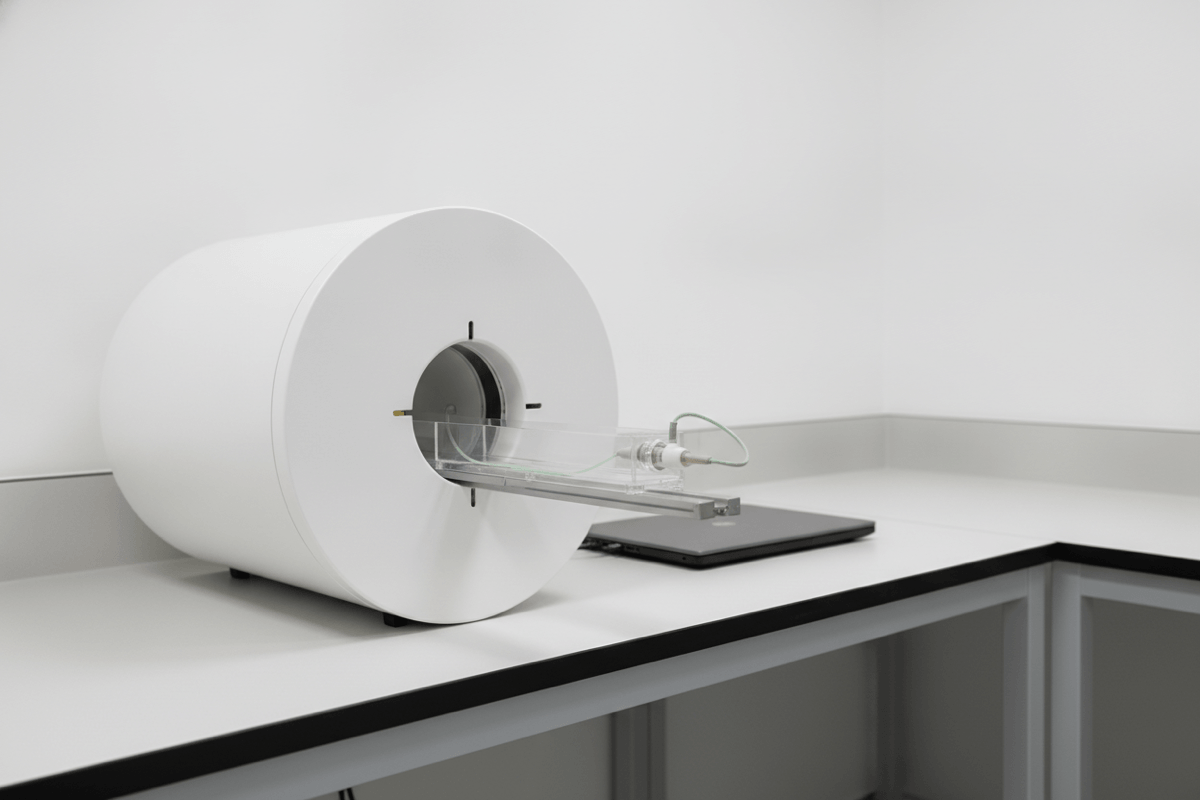
Safe in the magnet and invisible in the image are separate claims. A good answer names the modality and field strength tested, and comes with images.
The workflow: software, cost and failure
5. How does the ID reach my colony software without anyone retyping it?
The Guide already lists bar-coded and RFID cage cards among the ordinary means of identification,4 so machine-readable is nothing exotic. A good answer is a demonstration in the software you run: what the reader outputs, which field it goes into, and who does the setup if your system is homegrown. If someone still types it in, you have learned what you came to learn.
6. What does it cost per animal once labor is counted?
The unit price is only part of it. Add the readers or applicators, the minutes per animal to apply the mark, the seconds at every later read, and the cost of re-marking the ones that fail.
We looked for a published head-to-head comparison of total cost across methods and did not find one. A good answer is a worked example at your colony size, with the labor assumptions written down so you can change them.
7. What happens when one fails mid-study?
Every method fails sometimes. Tags come out, and a microchip that migrates can mean restraining the animal to read it.2 A good answer is a written procedure: how the animal is re-identified with certainty when its cage-mates look the same, what the backup identifier is, and how the record shows that the ID changed.
The one-page version
Screenshot it, or fold it into your badge holder.
| Ask | A good answer includes | Push back if you hear |
|---|---|---|
| 1. How was the read-error rate measured? | Who read, how many reads, live animals in cages or in hand; failed reads counted apart from wrong reads | A percentage with no method behind it |
| 2. What is the loss rate? | Number of animals, months of follow-up, strain and housing, controlled study or customer reports | No denominator, or a trial shorter than your study |
| 3. How young, and what does the animal need? | A postnatal day, the restraint and anesthesia involved, whether it is ever redone | An age range with no handling detail |
| 4. Tested in our scanner? | Modality and field strength tested, with images to look at | The word compatible, with no images |
| 5. How does the ID reach our software? | A live demonstration in the software you run; what the reader outputs and into which field | A slide, or a step where someone types |
| 6. Cost per animal with labor? | A worked example at your colony size, with the labor assumptions written down | A unit price on its own |
| 7. What happens when one fails? | A written re-identification procedure, a backup identifier, a record of the change | A claim that it does not fail |
Read down the middle column. Every good answer is specific enough that you could check it.
Our answers, since we’re asking
RapID Lab makes one of the methods on that floor: 2D-barcode ear tags for mice and rats. We sell them, so read this as a vendor answering, and hold us to the same questions. Here are our answers to the four we can put in writing.
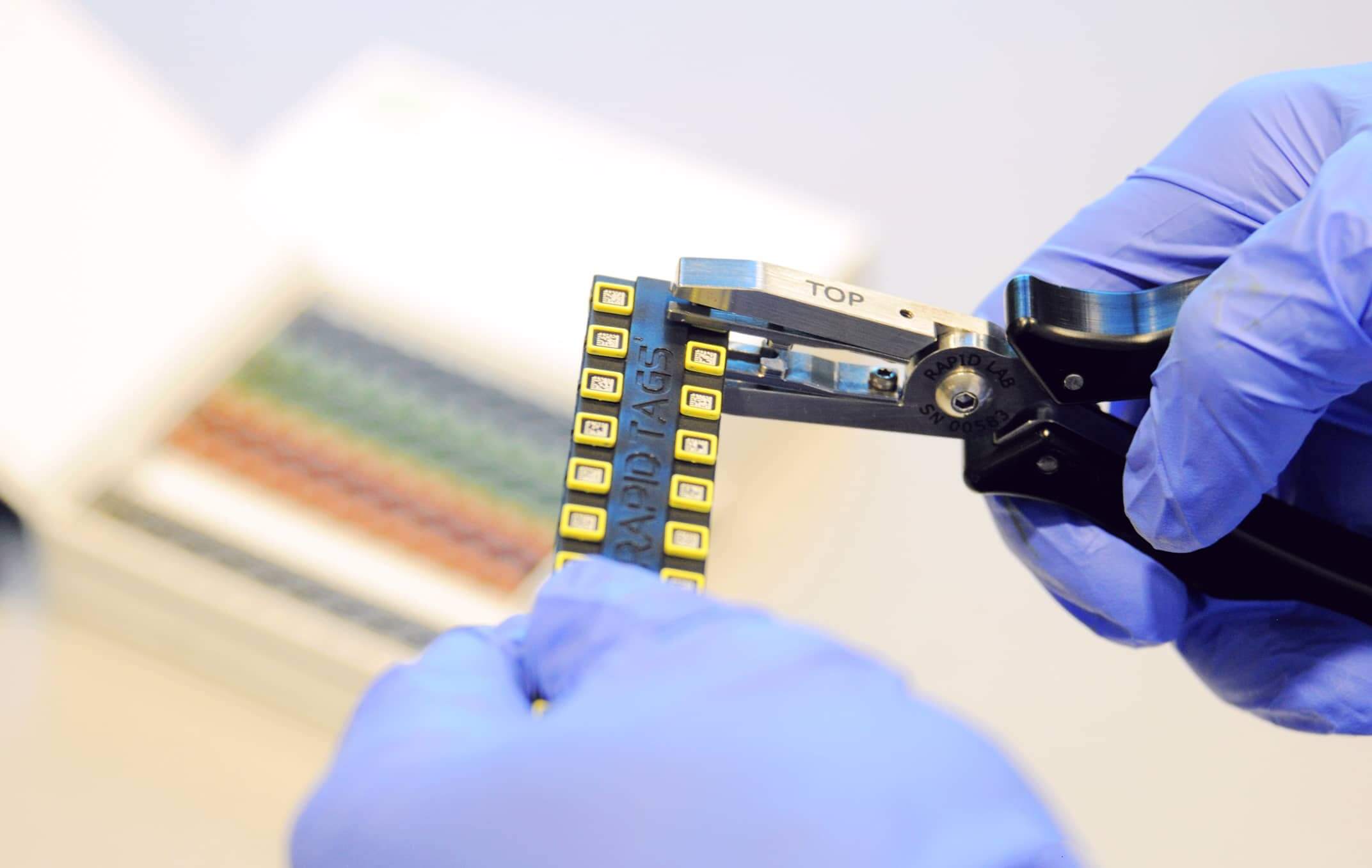
- Reads (question 1). Our tags are machine-readable, so a scanner reads the code instead of a person. That accurate read is what helps protect data integrity: the ID goes into the record as scanned, with no one deciphering or retyping it. Every tag code is also checked in QC before it ships. To scan, scruff the animal or hold it securely in one hand and scan with the other.
- Age and handling (question 3). The 3.5 mm Mini tag can be applied as early as postnatal day 12, and it never needs swapping as the animal grows, so a pup tagged in the breeding colony can keep the same ID through its whole study. The 5 mm Standard tag is applied at weaning or later. Both go on with standard scruff restraint and no anesthesia, though your facility’s protocols may ask for more.
- Imaging (question 4). On a 7T small-animal MRI system, the tags produced no artifacts. On CT they leave a clear, localized artifact without scatter, so the tag can be excluded from the analysis.
- When one comes out (question 7). A new tag goes on the other ear, and the record notes the animal’s secondary ID. Color helps here too. Standard tags come in five standard colors (up to ten available) and Mini tags in all ten, so many facilities give each mouse in a cage its own color and write the colors and IDs on the cage card. If a tag goes missing, it’s easy to work out whose it was.
We’ve left 2 and 6 for a conversation: loss depends on placement and enrichment, cost on your colony and labor rates, and a printed figure wouldn’t fit your facility. Question 5 we’d rather show you.
See the whole workflow at Booth #1346
At the booth we’re running a typical identification workflow, end to end:
- Loading the applicator and applying a tag
- Scanning the animal straight into study or colony management software
- Capturing measurements against that scan, so the ID and the data reach the record together, without retyping
Ask at the booth and we’ll also show a short demo of a biopsy collection workflow we’re developing.
Exhibit hall hours at the George R. Brown Convention Center:
- Sunday, Oct 25: 6:30 to 8:00 p.m.
- Monday, Oct 26: 9:00 a.m. to 5:00 p.m.
- Tuesday, Oct 27: 9:00 a.m. to 5:00 p.m.
- Wednesday, Oct 28: 9:00 a.m. to 1:00 p.m.
We’re also one of the partners in the Lab of the Future, a joint exhibit with Transnetyx, Allentown and PicoTeam. It starts at Transnetyx Booth #2020 and continues to each partner’s booth, ours included. Plan your visit.
References
- Dahlborn, K., Bugnon, P., Nevalainen, T., Raspa, M., Verbost, P., & Spangenberg, E. “Report of the Federation of European Laboratory Animal Science Associations Working Group on animal identification.” Laboratory Animals 47(1), 2-11 (2013). doi.org
- Roughan, J. V., & Sevenoaks, T. “Welfare and Scientific Considerations of Tattooing and Ear Tagging for Mouse Identification.” Journal of the American Association for Laboratory Animal Science 58(2), 142-153 (2019). pmc.ncbi.nlm.nih.gov
- Kitagaki, M., & Hirota, M. “Auricular Chondritis Caused by Metal Ear Tagging in C57BL/6 Mice.” Veterinary Pathology 44(4), 458-466 (2007). doi.org
- National Research Council. “Environment, Housing, and Management.” In: Guide for the Care and Use of Laboratory Animals, 8th ed. National Academies Press, 2011. ncbi.nlm.nih.gov
- Castelhano-Carlos, M. J., Sousa, N., Ohl, F., & Baumans, V. “Identification methods in newborn C57BL/6 mice: a developmental and behavioural evaluation.” Laboratory Animals 44(2), 88-103 (2010). doi.org
- Hipskind, E., Hernandez, N., Fox, S., et al. “Surgical removal of implanted microchips to correct MRI susceptibility artifacts in mice.” Magnetic Resonance in Medicine 94(6), 2593-2598 (2025). pmc.ncbi.nlm.nih.gov
About RapID Lab. RapID Lab makes minimally invasive, automated 2D-barcode ear tags for identifying rodents in preclinical research. We’re a small team in San Francisco focused on accurate, low-stress animal identification. rapidlab.com
This article is for general informational purposes and reflects RapID Lab’s perspective on industry practice. It is not regulatory advice, and it is not a substitute for your facility’s SOPs or current agency guidance.