Cage Card to LIMS: Where Rodent ID Data Actually Breaks Down
Posted on September 8, 2026
We’ve covered why a wrong ID quietly wrecks a study. This time the question is narrower: where, exactly, does the number go sideways? The answer starts earlier than the cage card.
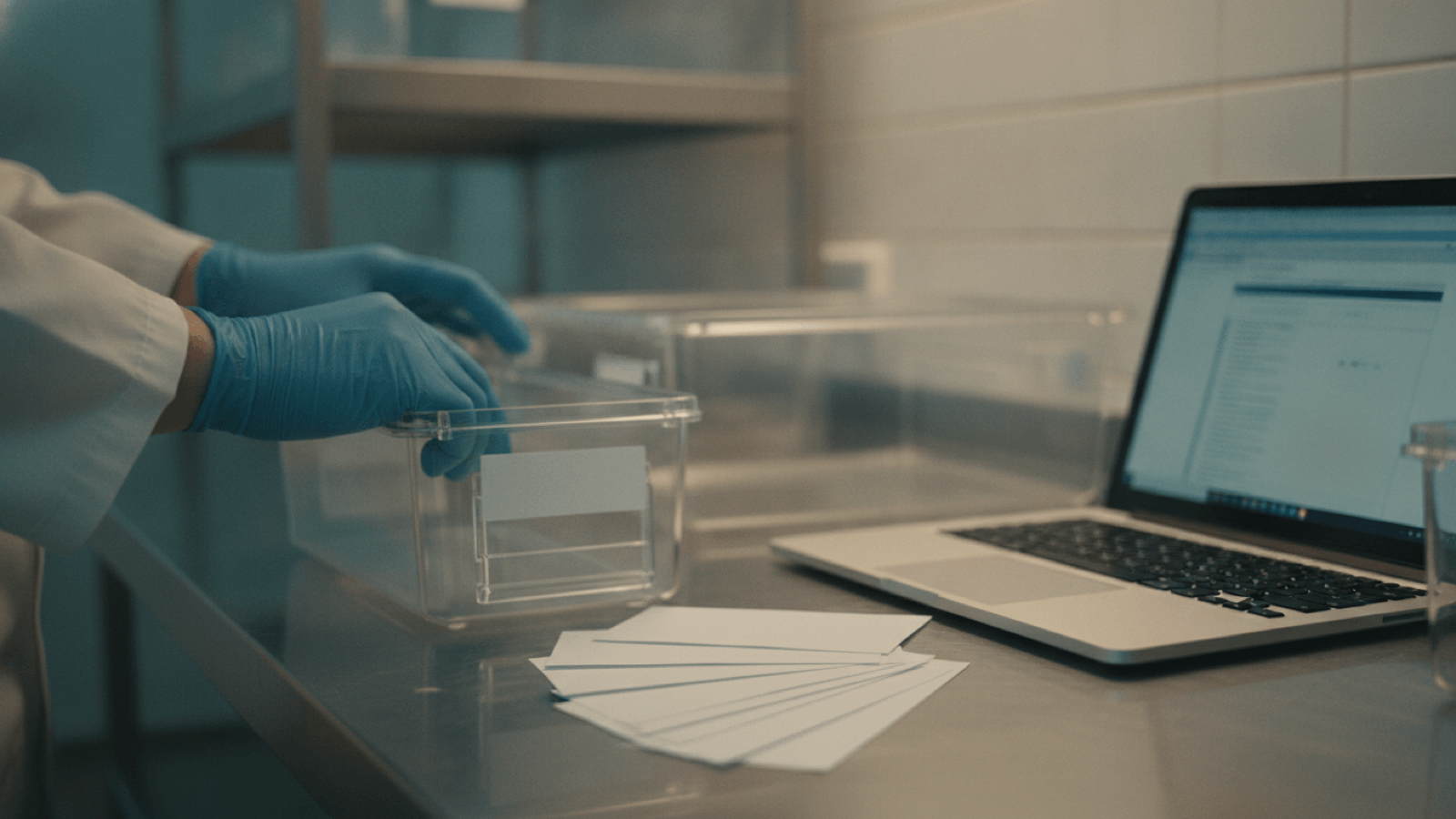
Pick one rat’s weight on a Tuesday afternoon and follow it. A technician reads it off a scale and writes it on the cage card in pencil. An hour later someone copies it onto a paper datasheet, because the protocol wants a running log at the rack. By evening it’s typed into a shared spreadsheet so the study director can see the week’s trend without walking the room. Sometime before the data locks, someone keys it into the LIMS. One number, written by hand four times, by however many people touched that cage across the day’s shifts.
Most facilities run some version of this chain, and it usually holds. But count the hops and you will probably start at the cage card. Start at the ear instead. Before anyone wrote the weight down, someone read the animal’s ID off the animal, and that read is a transcription too. Call it hop zero. Nobody counts it, and it is where this piece starts.
Hop zero: the ID is only as good as the read
An animal’s identifier is whatever a person managed to read off it, which is a less fixed thing than it sounds.
Most facilities pick from a short list: an ear punch or notch, a stamped metal ear tag, a tattoo, an implanted RFID microchip, or a 2D barcode ear tag. They fail in different ways, and only some of the failures are visible.
The most direct measurement of the reading problem comes from a Newcastle University study that asked ten staff members, three experienced and seven new, to identify BALB/c mice carrying either tattoos or metal ear tags. Every tattoo was read correctly, without picking the animal up. Every ear-tagged mouse had to be restrained to get a number off it, and at least 25 percent of the tag codes were misread.1 The paper’s own example makes the figure concrete: a tag stamped 799, read upside down and reversed, recorded as 661. Nothing about 661 looks wrong on a datasheet. It flows downstream, and the study now contains an animal that doesn’t exist. That is hop zero failing, before the cage card is even written.
Ear punches and notches carry a different version of the same weakness. They hold no number at all, only a pattern a person interprets against a key, and the pattern can be misapplied at weaning, can tear, and in some strains can partially close as the ear heals. Implanted microchips sidestep reading error: a reader either returns the ID or it doesn’t. A phenotyping study of chipped C57BL/6N mice found no meaningful effect on standard test outcomes apart from bone mineral density at DEXA, where the chip physically interferes with the measurement.2 The trade is visibility. A technician looking into a cage of five can’t tell them apart without a reader in hand.
| Method | Read by | In practice |
|---|---|---|
| Ear punch / notch | A person, against a key | Misapplied at weaning, can tear, can partially close as the ear heals in some strains |
| Stamped metal ear tag | A person | At least 25% of codes misread; every mouse had to be restrained to read one |
| Tattoo | A person | Read correctly, and read without picking the animal up |
| RFID microchip | A machine (reader) | Invisible without a reader in hand; interferes with DEXA bone-density readings |
| RapID Tags | A machine (scanner), plus color by eye | Needs line of sight to scan |
Read down the “Read by” column. Only the human-read methods have a reading-error rate at all. The machine-read ones fail by being unreadable at that moment, which is a different problem and a visible one.
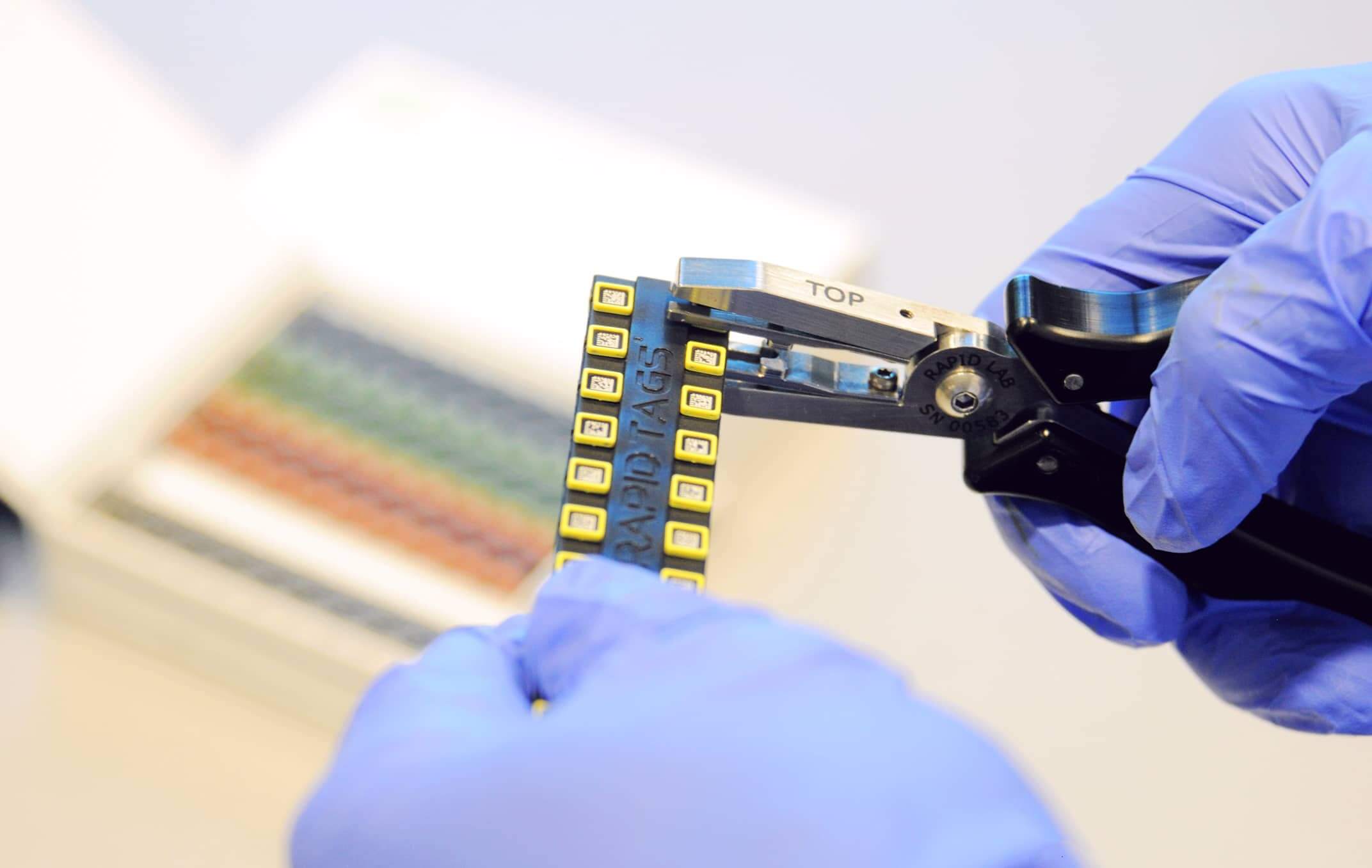
The split that matters for the rest of the chain isn’t permanent versus temporary, or invasive versus not. It’s whether a person or a machine does the reading. A stamped tag and a notch pattern are both human-read, so hop zero happens at the animal, silently, before anything is written down. A barcode or a microchip is machine-read, and hop zero doesn’t exist.
Hops one through four
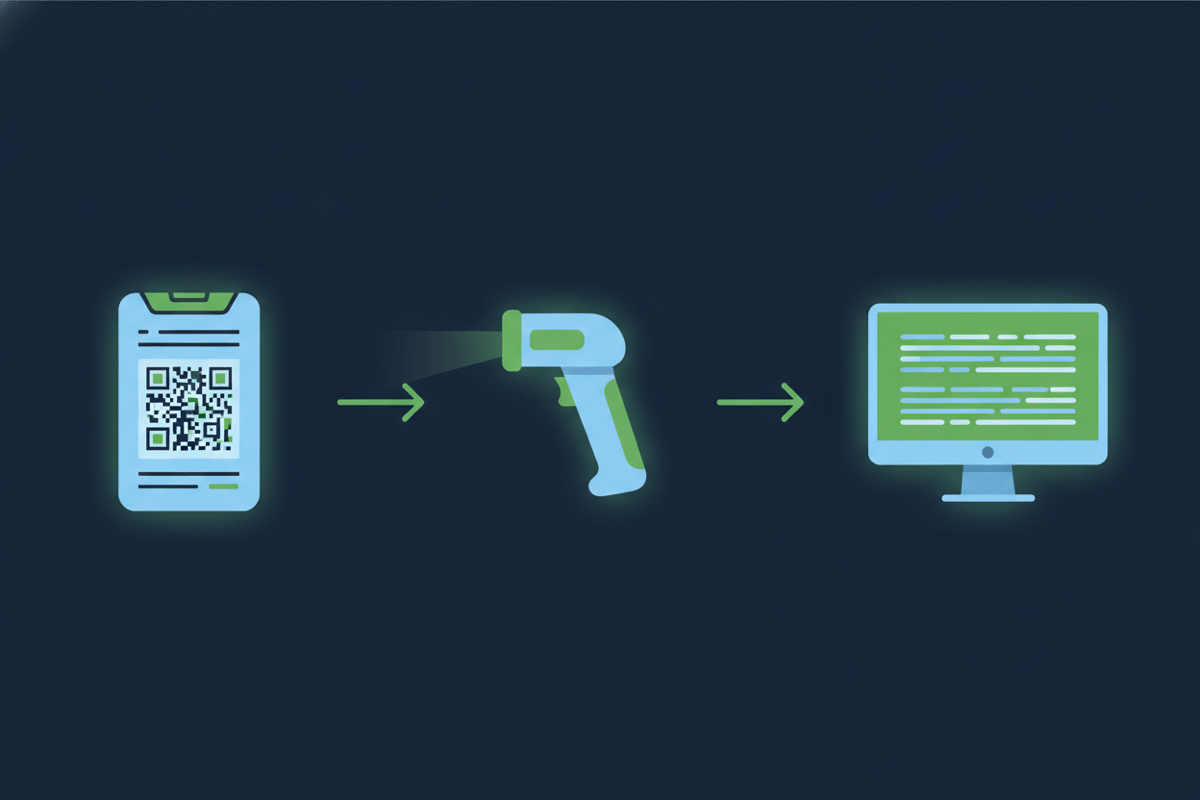
Handwritten card, paper datasheet, spreadsheet, LIMS. Each arrow between those four is a person re-copying a number that already exists somewhere in the room. A barcode or 2D data-matrix code can shortcut part of it, carrying the ID from the animal into the software without anyone retyping. Plenty of labs still run the manual version end to end, and even the ones with a scanner tend to keep at least one manual hop downstream, usually the last, from a spreadsheet into the LIMS.
Shift handoffs add a wrinkle nobody designs on purpose. A card gets written at the end of one shift and entered the next morning by a different technician. There is nothing to check the typed number against except a pencil mark that may already be smudged.
How much the hops cost
Here is a real number, from a different corner of research. A study of outpatient point-of-care testing measured how often trained clinical staff introduced an error transcribing a glucose reading from a device into the record, checking each manual entry against the automated instrument reading it was supposed to match. The discrepancy rate was 3.7 percent, across 6,930 paired entries and 506 staff members. About 14 percent of those errors were off by more than 20 percent, the kind of gap that turns 132 into 13.3 That was a single hop, with an automated reading available to check against. A vivarium chain has more hops than that and rarely anything automated checking the human’s work.
Clinical research data is closer to what a vivarium produces, and the pattern holds. When study coordinators keyed trial data into case report forms and an automated pull from the source record ran alongside them, the two agreed exactly 89 percent of the time. Where they disagreed and a reviewer adjudicated, the manual entry was at fault in 152 of 196 cases.4
The error doesn’t need to be a misread digit. A common failure at the spreadsheet-to-LIMS hop: someone deletes a blank row while cleaning up a sheet, then copies a column that is now three rows out of alignment with the cage IDs beside it. Every number is plausible. Nothing announces itself.
Collapse the hops you can, watch the ones you can’t
The fix is fewer chances to retype. Capture the ID once, at the animal, and let it travel without being rewritten, and the hops where drift gets in stop existing rather than needing to be policed. The mechanism has been measured outside the vivarium: when a hospital replaced manual matching in medication administration with barcode scanning at the bedside, reported administration errors fell 43.5 percent, from about 37 per 100,000 doses to about 21, and events that reached a patient fell 55.4 percent.5
Where scanning isn’t practical for every hop, the honest fallback is reconciliation that checks the electronic record against the animal, not the paper log against itself. A weekly census that compares one stack of paper to another will confirm the cards agree with each other. It won’t catch the case where the cards were fine and the keyed-in number wasn’t. FDA’s data-integrity guidance leans on exactly this distinction, describing records that are attributable and contemporaneous, tied to the moment and the person who made them, as the standard the rest of the chain should be measured against.6
What it looks like when a facility closes the loop
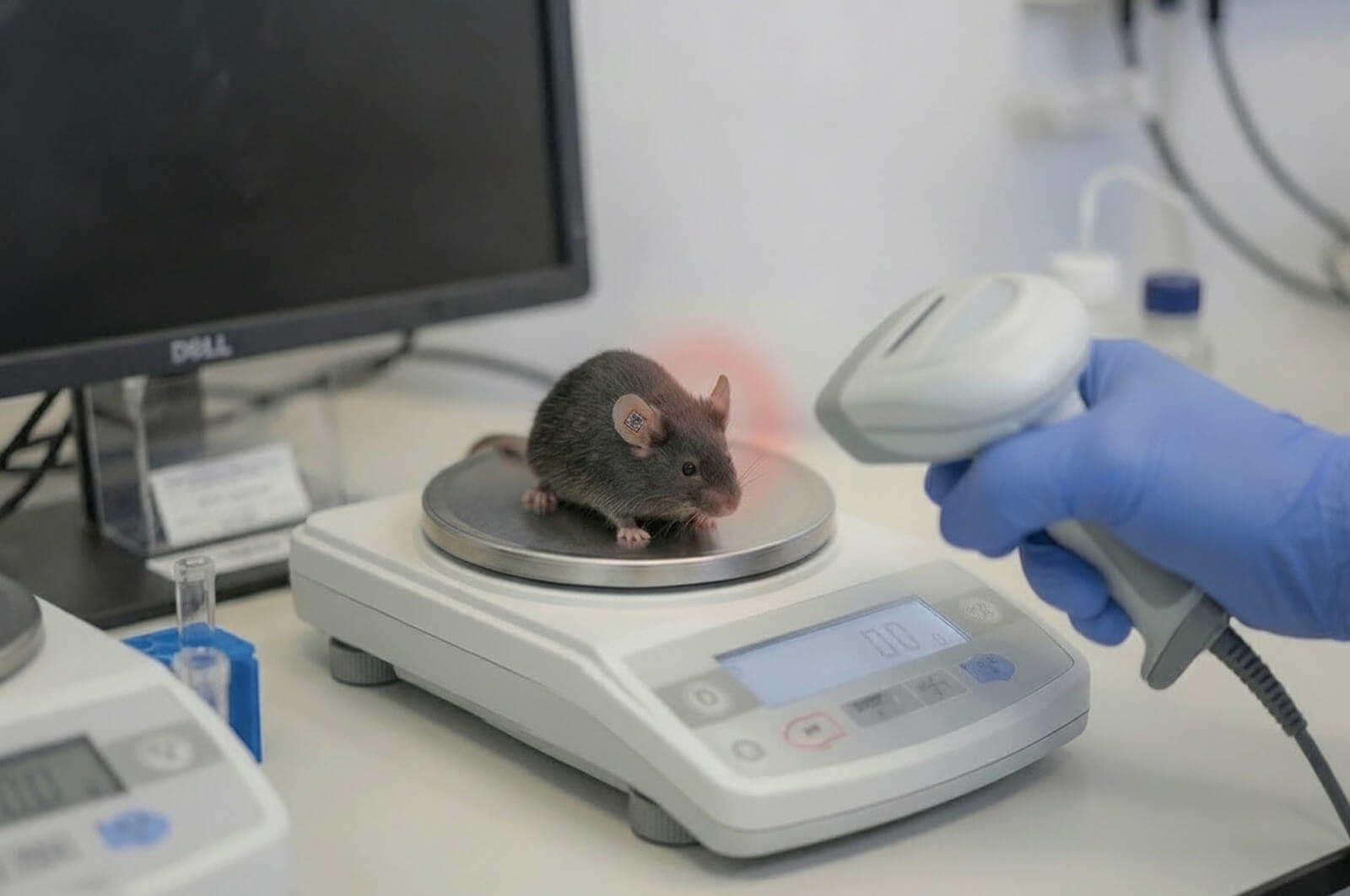
At the 2023 National AALAS meeting, Steve Sansing, Sr. Client Portfolio Manager for Research Models and Services at Charles River, presented how their genetically engineered models group handles identification inside their Internet Colony Management system. The animals carry a 3.5 mm RapID mini tag, a 2D barcode ear tag small enough to apply pre-weaning from about day 12, produced in ten colors.7
Two design choices from that talk are worth stealing whatever tag you use.
First, scanning is a gate. Validation is required at the touchpoints where getting the animal wrong is expensive: mating, clinical observation, euthanasia, shipment, cage move, and sampling. Scan an animal that isn’t part of the task and the system refuses it and says so on screen. The check lands at the bench, in the second before the action, instead of in a reconciliation report the following week.
Second, the cage card changes direction. Their cards are generated by the system, printed with both the tag number and the tag color as a secondary visual check. The card stops being where data originates and becomes a view of what the database already holds. For a piece about the trip from cage card to LIMS, that is the argument in one artifact: the shortest trip is the one where the card was never the source.
What they reported are operational outcomes, not a controlled comparison: no animal identification issues, no cohort deliveries reduced because of an incorrect ID or an unreadable ear mark, and fewer shipping crates, because animals of different genotypes can be co-housed when a color tells them apart on sight. That last one is a welfare gain falling out of a data-integrity decision, which is rare enough to note. Treat the numbers as what they are, an operator’s account of their own system at a trade meeting rather than a peer-reviewed result, and note our stake in it: the mini tag was developed with us, and those are our tags.
Count your own hops
Nobody needs to redesign their pipeline this quarter. The useful exercise is smaller: trace one data point, the way we did at the top, from the animal to wherever it finally locks, and count the hops. Start at the ear, not the cage card. Wherever a person is reading or retyping a value that already exists in machine-readable form somewhere in the room, that is a hop to fix, and the ones furthest from the animal are the ones nobody downstream can check.
Where we sit on this. Full disclosure: RapID Lab makes the 2D-barcode ear tags described above, built to be scanned at the cage rather than read and typed, and Charles River is a customer. So this argument runs in our favor. We think it holds regardless of whose reader is on the bench: the fewer times a number gets rewritten by hand between the animal and the LIMS, the fewer chances it has to become a different number. What we can’t promise is that a scanner fixes a facility’s reconciliation habits on its own. A technician can scan the wrong animal with just as much confidence as they can transpose a digit; the systems piece, checking the record against the animal and not just the paperwork, still needs a policy behind it.
References
-
- Roughan, J. V., & Sevenoaks, T. “Welfare and Scientific Considerations of Tattooing and Ear Tagging for Mouse Identification.” Journal of the American Association for Laboratory Animal Science 58(2), 142-153 (2019). pmc.ncbi.nlm.nih.gov
-
- “The effects of microchipping C57BL/6N mice on standard phenotyping tests.” F1000Research 9:20 (2020). pmc.ncbi.nlm.nih.gov
- Mays, J. A., & Mathias, P. C. “Measuring the rate of manual transcription error in outpatient point-of-care testing.” Journal of the American Medical Informatics Association 26(3), 269-272 (2019). pmc.ncbi.nlm.nih.gov
- Cheng, A. C., Banasiewicz, M. K., Johnson, J. D., et al. “Evaluating automated electronic case report form data entry from electronic health records.” Journal of Clinical and Translational Science 7(1), e29 (2022). pmc.ncbi.nlm.nih.gov
- Thompson, K. M., Swanson, K. M., Cox, D. L., et al. “Implementation of Bar-Code Medication Administration to Reduce Patient Harm.” Mayo Clinic Proceedings: Innovations, Quality & Outcomes 2(4), 342-351 (2018). pmc.ncbi.nlm.nih.gov
- U.S. Food and Drug Administration. “Data Integrity and Compliance With Drug CGMP: Questions and Answers.” Guidance for Industry, December 2018. fda.gov
- Sansing, S. “Genetically Engineered Models: Use of a 2D Barcode Mini Tag for Identification of Mice in an Automated Colony Management System.” Presented at the 2023 National AALAS Meeting, Salt Lake City, November 2023. Slide deck (PDF)
For the earlier argument (why a wrong ID becomes a silent data problem in the first place), see our piece The Quietest Threat to Your Study’s Validity: A Mislabeled Cage.
About RapID Lab. RapID Lab makes minimally invasive, automated 2D-barcode ear tags for identifying rodents in preclinical research. We’re a small team in San Francisco focused on accurate, low-stress animal identification. rapidlab.com
This article is for general informational purposes and reflects RapID Lab’s perspective on industry practice. It is not regulatory advice, and it is not a substitute for your facility’s SOPs or current agency guidance.