Rodent Identification Is Nobody’s Job
Posted on November 10, 2026

We spent four days in Houston asking facilities how they identify their mice. The honest answer, over and over, was “it depends on the lab.”
We came back from the AALAS National Meeting with about 180 booth conversations written up, most of them with the people who handle rodent identification every day: attending veterinarians, residents, breeding-core staff, trainers, technicians. We expected to hear about methods. We mostly heard about who gets to choose one.
One caveat first. These are notes from one vendor’s booth, taken by our own reps, with people who chose to walk up. A signal, not a survey, and nobody is named or quoted below.
Who decides how a mouse is identified
In academic facilities the answer was almost always the same: the principal investigator. One attending veterinarian described the campus as a republic. Each lab picks its own identification method and its own software, and the facility, the veterinary staff, the trainers and the breeding core can recommend but not decide.
Variety itself is old news. A survey of UK facilities, reported in a 2021 welfare study, found ear punching or notching at 85 percent of respondents and tail marking with a pen at 63 percent, with methods overlapping from site to site.1 A FELASA working group concluded there is no gold standard, because each situation is unique.2 Variety is fine. The problem is variety with no owner.

Here is what no owner looks like, as people described it at the booth:
- A breeding core ear-notches animals so they can leave the door with some identifier, and the receiving lab applies its own method on arrival. Some animals end up carrying two or three.
- A facility that wants to pilot a single method cannot tell which labs breed the most animals, so it cannot pick where to start.
- Health-concern conversations between the facility and a lab stall because nobody can say which mouse is which.
- The trainers who see every new hire’s tagging technique do not choose what they are training on.
None of these is a product problem. They are governance problems wearing a product costume.
The symptoms land on someone else’s desk
The people most frustrated on the floor were veterinary residents. At two institutions they are called down to the vivarium up to several times a day for metal ear tags: placed too deep, placed in odd spots, embedded, inflamed, or torn out and leaving an animal with no identity. The only remedy available to them is retraining, because the method is not theirs to change.
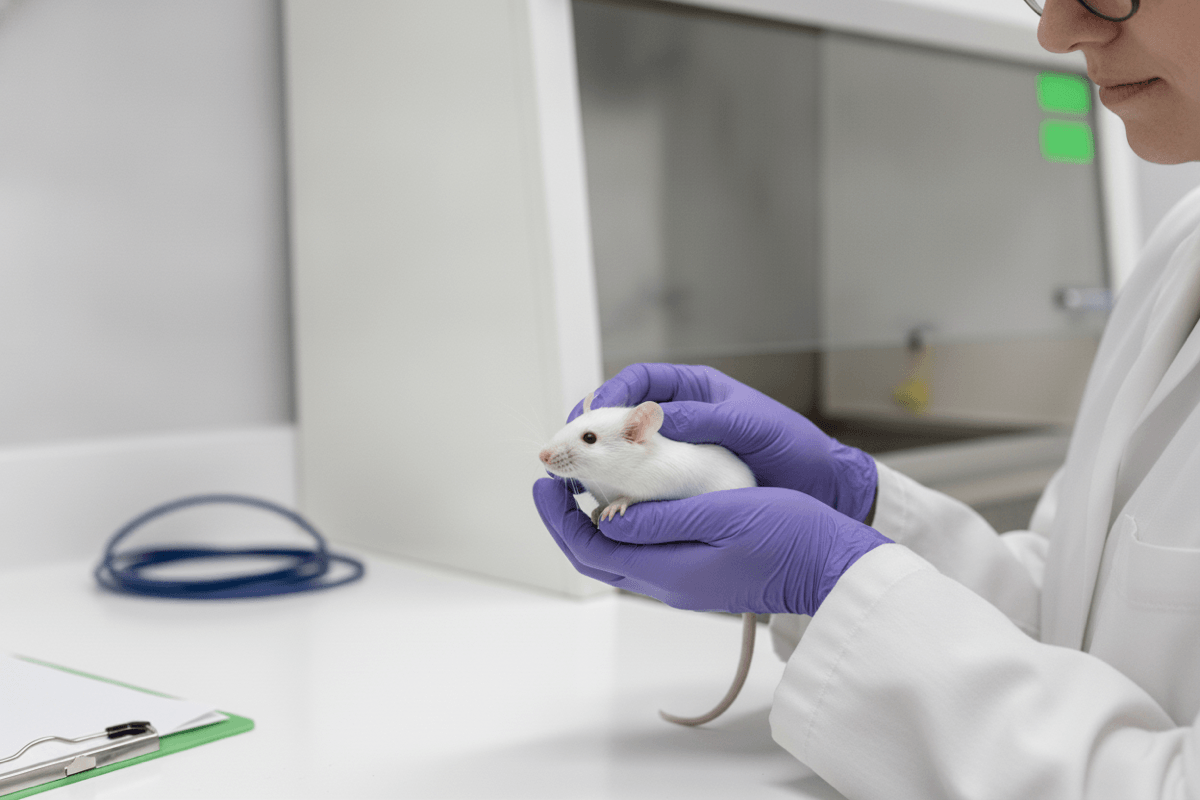
The literature says the complaints are not anecdotal. In C57BL/6 mice, visible thickening of the tagged ear was recorded 26 weeks after metal tagging.3 When ten staff read stamped metal tags on BALB/c mice, every animal had to be restrained to read it, and a tag stamped 799 was recorded upside down as 661.4
What struck us is that nobody logs these calls. Facilities that track cage-change intervals to the day could not tell us how many veterinary visits last month were about an identifier. A cost that is never measured stays unowned.
Rodent identification before weaning, where the rules move first
The second place the gap showed was timing. Two institutions told us toe clipping is banned or being phased out from January 1, and at least one was still assembling the list of alternatives. That is consistent with where guidance has been heading: the Guide says toe clipping should be used only when no other individual identification method is feasible,5 and institutional policies now commonly restrict it to neonates under seven days with scientific justification in the protocol.6
The practical gap is pre-weaning identification. One director told us button tags and tattoos are not usable in his hands until about day 23. Breeding programs want an identity between day 12 and day 19. Several people want the identifier and the genotyping tissue taken in one step, and asked what happens to genotyping tissue once an ear carries a tag. One production site genotypes before day 12, gets results back near weaning, and culls heavily at that point, so it does not want to pay for identifiers on animals it will never follow.
A ban with no owner for the replacement is a ban that lands on the breeding core.
Where identification technology does not work
We make one of the methods on that floor, so this section matters. Every one of these came from an attendee, and no identification product on the market answers all of them:
- Rooms that admit no electronic devices: BSL2 and BSL3 suites, barrier rooms for microbiome work, a military site with USB ports disabled. In those rooms the only part of a barcode system that still works is the color on the tag, and people said that is not enough on its own.
- Animals with no line of sight: a burrowing-rodent colony with dozens of animals per tank, or a primate facility where tag colors could not be told apart through the cage.
- Studies that last days, where a tail mark is cheaper than any tag.
- Endpoints that need the chip itself: temperature telemetry, or an fMRI workflow built around implants.
- Pups too small for any tag, even a mini, because a lab needs to sample at day 16 from runted litters.
- Single use. A torn-out tag is a re-identification event, and tags bought for animals culled at weaning are sunk cost.
And one from the other side of the aisle. A home-cage monitoring vendor told us their cameras avoid reading individual identifiers because of the data load, so cage-level identity rests on the cage card. The TEATIME welfare group calls telling apart group-housed animals an unaddressed challenge,7 and a cage card that gets swapped is the oldest failure in the building. We wrote about the hours those systems watch in Home-Cage Monitoring: The Night Shift; identity is still the join key they are missing.
Three questions that find the owner
A facility does not need to buy anything to act on this. It needs to find out whether rodent identification has an owner, and three questions at the next operations meeting will do it.
| Who | Sees the problem | Can change the method |
|---|---|---|
| Breeding core | Animals leave with one identifier and come back with another | No |
| Attending vet and residents | Tag complications, torn-out identifiers, animals nobody can name | No |
| Trainers | Every new hire’s technique, every misplaced tag | No |
| Facility manager | Inconsistency across rooms, scanners nobody can share | Recommend only |
| Principal investigator | Their own colony | Yes |
Read down the right-hand column. Everyone who sees the problem is in the “No” rows.
- Who signs off on the identification method in a new protocol, and is that answer the same in every room? If the honest answer is “the lab”, you have found the gap, not an owner.
- How many identification methods are live in the building today? Count them. Then ask how many animals carry more than one.
- How many veterinary calls last month were about an identifier? If nobody knows, start a tally. A number is the thing that turns an annoyance into a line item.
The goal is not a mandate. Investigators have real reasons to differ, and the FELASA conclusion stands.2 The goal is a short approved menu, one identity that survives the trip from breeding core to lab, and a tally of what the current arrangement costs the veterinary staff. Each of those has a natural owner in most facilities. Nobody has given them the job yet.
Thanks to everyone who stopped by Booth #1346 in Houston and told us how it really works in your building.
References
- Burn, C. C., Mazlan, N. H. B., Chancellor, N., & Wells, D. J. “The Pen Is Milder Than the Blade: Identification Marking Mice Using Ink on the Tail Appears More Humane Than Ear-Punching Even with Local Anaesthetic.” Animals 11(6), 1664 (2021). pmc.ncbi.nlm.nih.gov
- Dahlborn, K., Bugnon, P., Nevalainen, T., Raspa, M., Verbost, P., & Spangenberg, E. “Report of the Federation of European Laboratory Animal Science Associations Working Group on animal identification.” Laboratory Animals 47(1), 2-11 (2013). doi.org
- Kitagaki, M., & Hirota, M. “Auricular Chondritis Caused by Metal Ear Tagging in C57BL/6 Mice.” Veterinary Pathology 44(4), 458-466 (2007). doi.org
- Roughan, J. V., & Sevenoaks, T. “Welfare and Scientific Considerations of Tattooing and Ear Tagging for Mouse Identification.” Journal of the American Association for Laboratory Animal Science 58(2), 142-153 (2019). pmc.ncbi.nlm.nih.gov
- National Research Council. “Environment, Housing, and Management.” In: Guide for the Care and Use of Laboratory Animals, 8th ed. National Academies Press, 2011. ncbi.nlm.nih.gov
- UCLA Research Safety & Animal Welfare Administration, Animal Research Committee. “Toe-clipping for Animal Identification.” rsawa.research.ucla.edu
- COST Action TEATIME CA20135 welfare group. “Advocating for automation in animal research: using home cage monitoring to advance welfare, reproducibility and scientific openness.” Disease Models & Mechanisms 18(10), dmm052669 (2025). pmc.ncbi.nlm.nih.gov
About RapID Lab. RapID Lab makes minimally invasive, automated 2D-barcode ear tags for identifying rodents in preclinical research. We’re a small team in San Francisco focused on accurate, low-stress animal identification. rapidlab.com
This article is for general informational purposes and reflects RapID Lab’s perspective on industry practice. It is not regulatory advice, and it is not a substitute for your facility’s SOPs or current agency guidance.