Vivarium Lighting Is a Variable, Not a Fixture
Posted on October 1, 2026
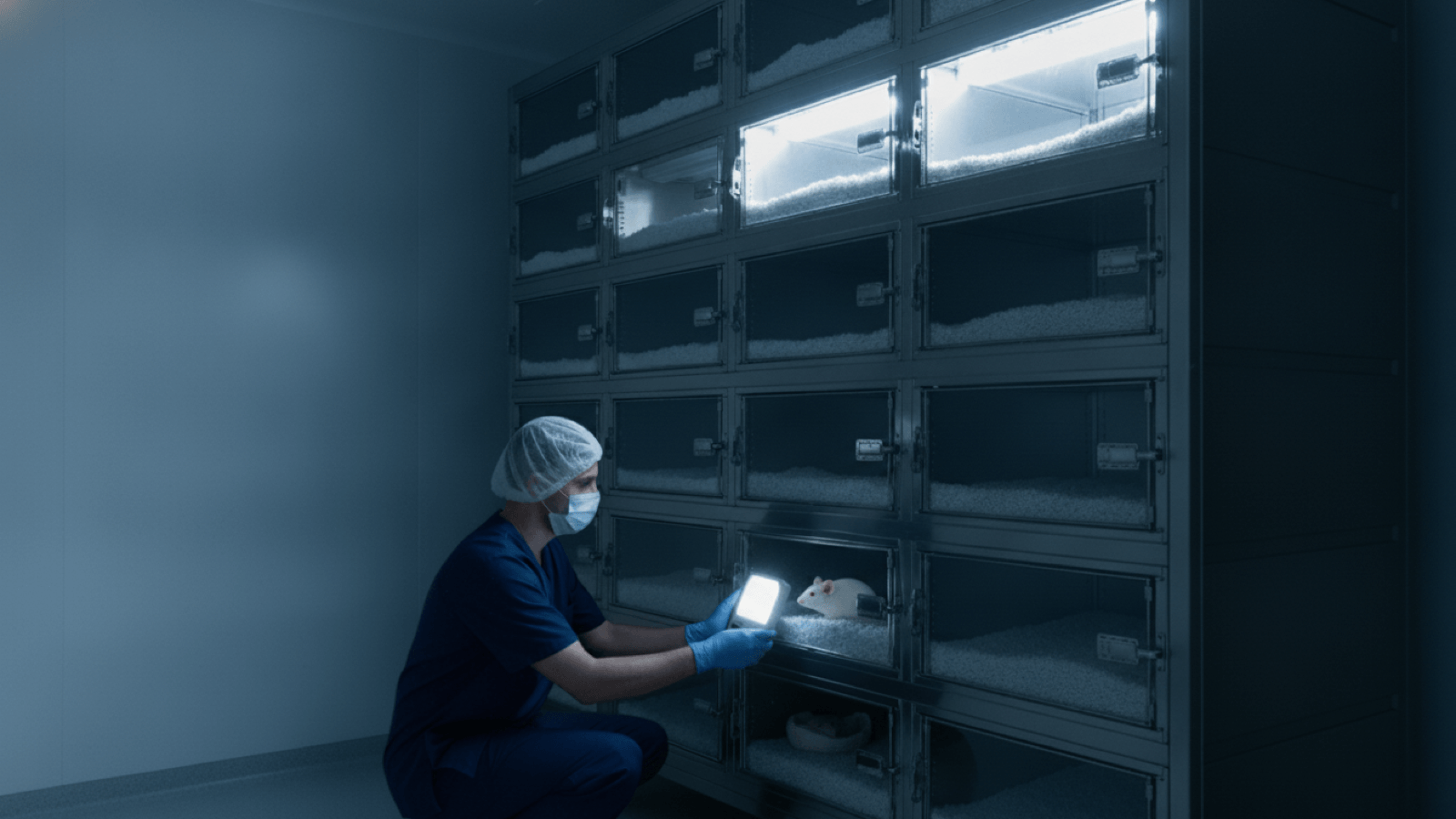
Everyone remembers to set the light timer. Almost nobody checks what the cage on the bottom shelf is actually getting.
Ask a facility manager whether their vivarium lighting is under control and most will say yes without pausing. The room lights run on a timer. Nobody flips the switch during the dark phase. On a long checklist, it looks like one of the solved items.
Lighting isn’t one item, though. It’s at least four, stacked:
- Photoperiod: how long the lights stay on each day.
- Intensity at the cage: what the animal gets, which is not what the room gets.
- Wavelength: what color that light is.
- Darkness: whether the dark phase is actually dark.
Checking the timer confirms the first one.
Light is a signal the animal reads
Rodents don’t just see by light. They keep time by it. A class of retinal cells containing the pigment melanopsin reports light levels straight to the brain’s master clock, which sets the nightly rise in melatonin and, downstream of it, activity, body temperature and metabolism.
Those cells are sensitive. Melanopsin-driven signaling can be triggered by less than 1 lux, and circadian responses peak in the blue part of the spectrum, roughly 447 to 484 nanometers.1 Change the light and you’ve changed the animal’s calendar, whether or not anyone meant to.
The vivarium lighting gradient on every rack
The room can be on a perfect schedule while individual cages are not. Researchers at Oxford measured light inside every cage of a digital ventilated cage rack and found intensity falling from top left to bottom right, with more than a 15-fold difference between the brightest and dimmest standard cages. The top row alone ran from about 178 lux to about 30.2
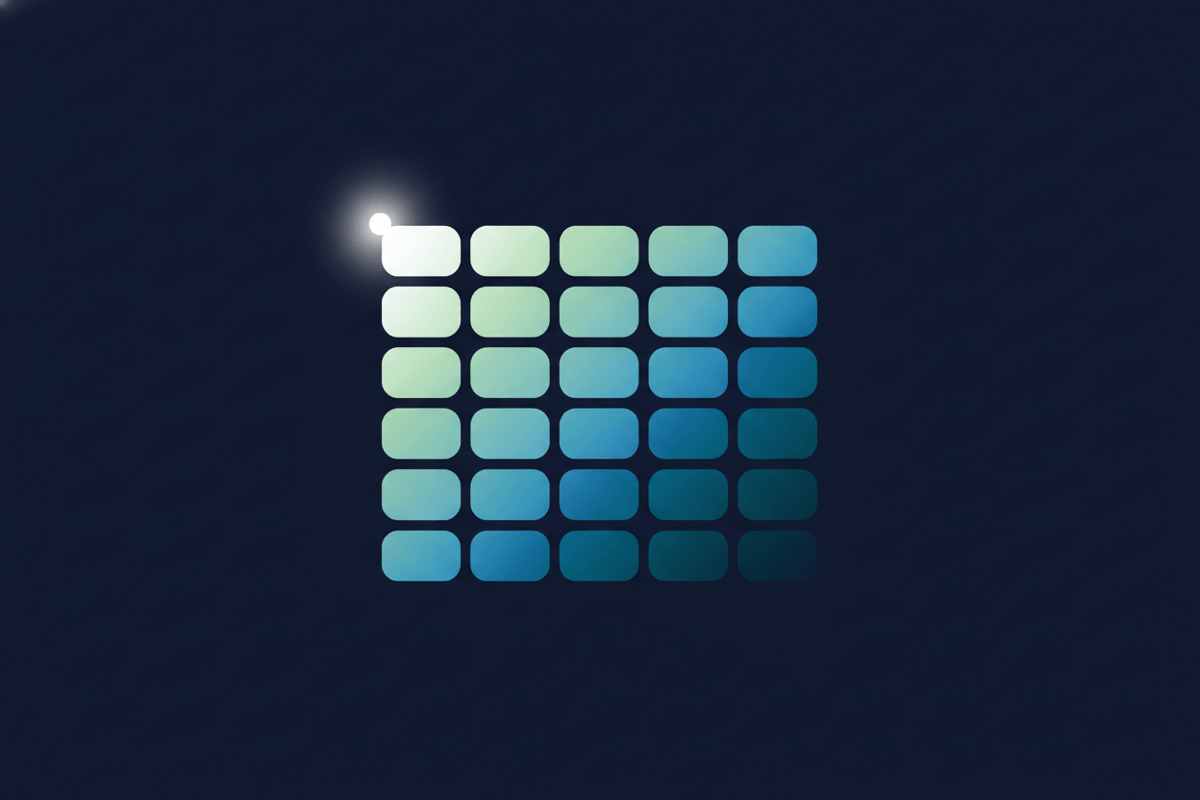
The animals noticed. Mice in dimmer cages did more of their activity during the light phase and showed weaker day-night rhythms, and melanopic light (weighted for those clock cells) predicted the effect better than a standard lux reading did. The authors’ recommendation is plain: factor cage position into study design and report the light levels animals actually experienced.2
So if a study spans a rack, shelf position is riding along as a variable nobody assigned.
A rack isn’t lit. It’s lit unevenly, and the unevenness is the part nobody schedules.
The dark phase that wasn’t
The opposite failure is light getting into the night.
At one cancer research facility, the animal rooms went dark on schedule, but the animal room doors had a standard 10 by 12 inch translucent window facing a lit corridor. At rat eye level, that leak measured about 60 lux through the whole dark phase.3 Nothing about it looked like a protocol violation. It was a door.
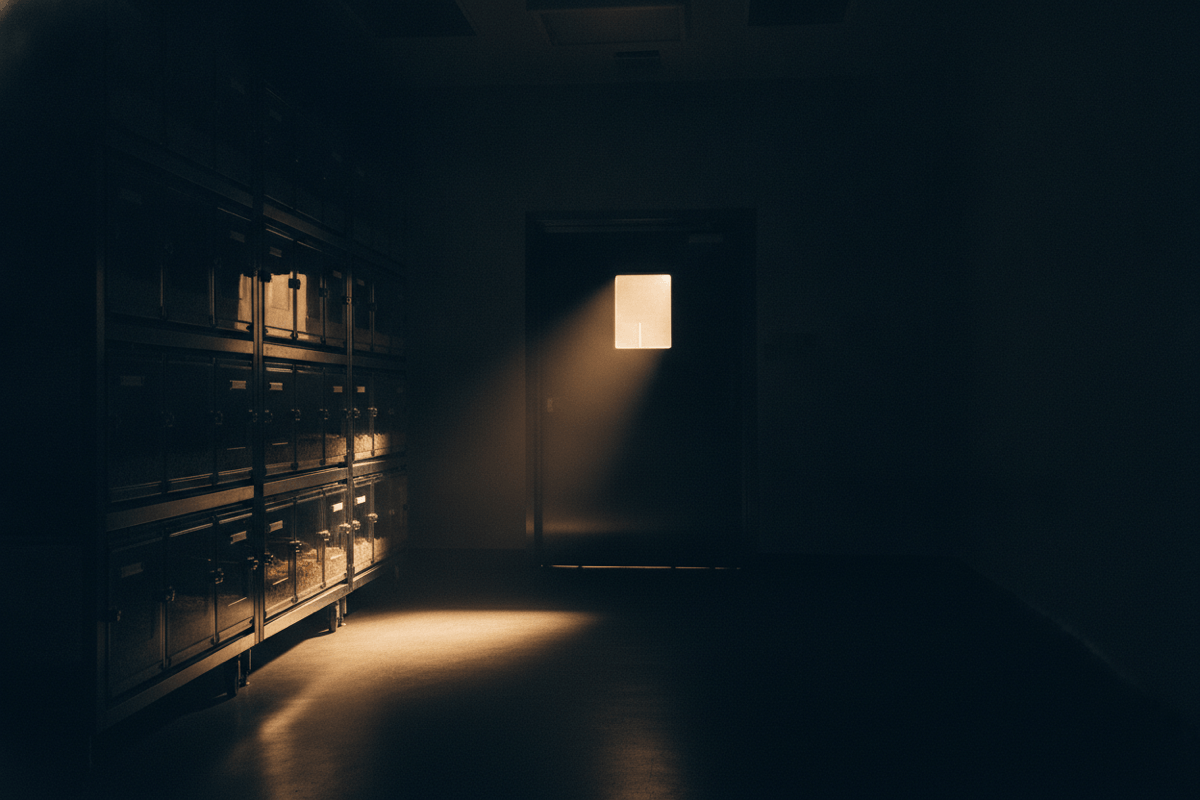
The team sealed it with a light-proof curtain on the door plus gaskets and sweeps around the frame. Nighttime melatonin in the rats returned to normal. Growth rates of the tumor models they were studying dropped by more than half:3
The same group has since reported that as little as 0.2 lux of light at night, for as little as two hours, is enough to disrupt circadian patterns in several rat and mouse strains.1 Nocturnal rodents are built to notice almost any light during their night.
Red light helps. It isn’t free.
Red lighting for dark-phase work is standard advice, and it’s better than white. It is not invisible to the animal. Dim red “safety” light at 15 lux was enough to disrupt nighttime melatonin in Syrian hamsters. The practical guidance from the same review: if staff need light in the dark phase, keep it dim red, under 35 lux, for less than 15 minutes.1
What to check this week
None of this needs a retrofit. It needs a light meter held at the cage rather than the ceiling, and a habit of writing down what it says.
| Variable | What to check | Reference point |
|---|---|---|
| Photoperiod | Timer performance, on a schedule, not only at install | The Guide: use a time-controlled system and check its performance regularly4 |
| Intensity at the cage | A reading at animal eye level on the top, middle and bottom shelf | The Guide: about 325 lux at 1 m above the floor suffices for animal care; albino rats prefer under 25 lux.4 Dauchy and Blask: aim for about 75 lux or less inside the cage1 |
| Wavelength | What staff use for dark-phase work | Dim red, under 35 lux, for under 15 minutes1 |
| Darkness | Door windows, equipment LEDs, hallway spill, with a reading taken in the dark room | Target 0 lux; 0.2 lux has disrupted rhythms1 |
Read down the middle column. Every check is a measurement at the animal, not a setting on a panel.
Then log it. Record rack position for each cage the way you’d record diet lot or bedding substrate, and note the readings. The Guide already suggests rotating cage position relative to the light source;4 if you rotate, write down when.
The takeaway
Lighting gets less scrutiny than diet, bedding or handling because it’s invisible in a way they aren’t. Nobody has to remember to turn it on, which is exactly why it drifts. A rack moves a few feet. A door gets a window. A relay starts to stick.
Treat photoperiod, cage-level intensity, wavelength and darkness as four separate checks, measured where the animal sits. It’s a small habit, and it takes one variable off the list of things that could explain a confusing result.
Where we sit on this. We make animal identification hardware, not lighting, so we have no stake in which fixtures a facility buys. Our interest is the broader point: quiet, unmeasured variables are where good data goes wrong, the same argument we’ve made about a mislabeled cage. Light or ID, the instinct is the same. Measure it where it matters, and write it down.
References
- Dauchy, R. T., & Blask, D. E. “Vivarium Lighting as an Important Extrinsic Factor Influencing Animal-based Research.” Journal of the American Association for Laboratory Animal Science 62(1), 3-25 (2023). pmc.ncbi.nlm.nih.gov
- Steel, L. C. E., Tir, S., Tam, S. K. E., et al. “Effects of Cage Position and Light Transmission on Home Cage Activity and Circadian Entrainment in Mice.” Frontiers in Neuroscience 15:832535 (2022). pmc.ncbi.nlm.nih.gov
- Dauchy, R. T., Dupepe, L. M., Ooms, T. G., et al. “Eliminating Animal Facility Light-at-Night Contamination and Its Effect on Circadian Regulation of Rodent Physiology, Tumor Growth, and Metabolism.” Journal of the American Association for Laboratory Animal Science 50(3), 326-336 (2011). pmc.ncbi.nlm.nih.gov
- National Research Council. “Environment, Housing, and Management.” In: Guide for the Care and Use of Laboratory Animals, 8th ed. National Academies Press, 2011. ncbi.nlm.nih.gov
About RapID Lab. RapID Lab makes minimally invasive, automated 2D-barcode ear tags for identifying rodents in preclinical research. We’re a small team in San Francisco focused on accurate, low-stress animal identification. rapidlab.com
This article is for general informational purposes and reflects RapID Lab’s perspective on industry practice. It is not regulatory advice, and it is not a substitute for your facility’s SOPs or current agency guidance.